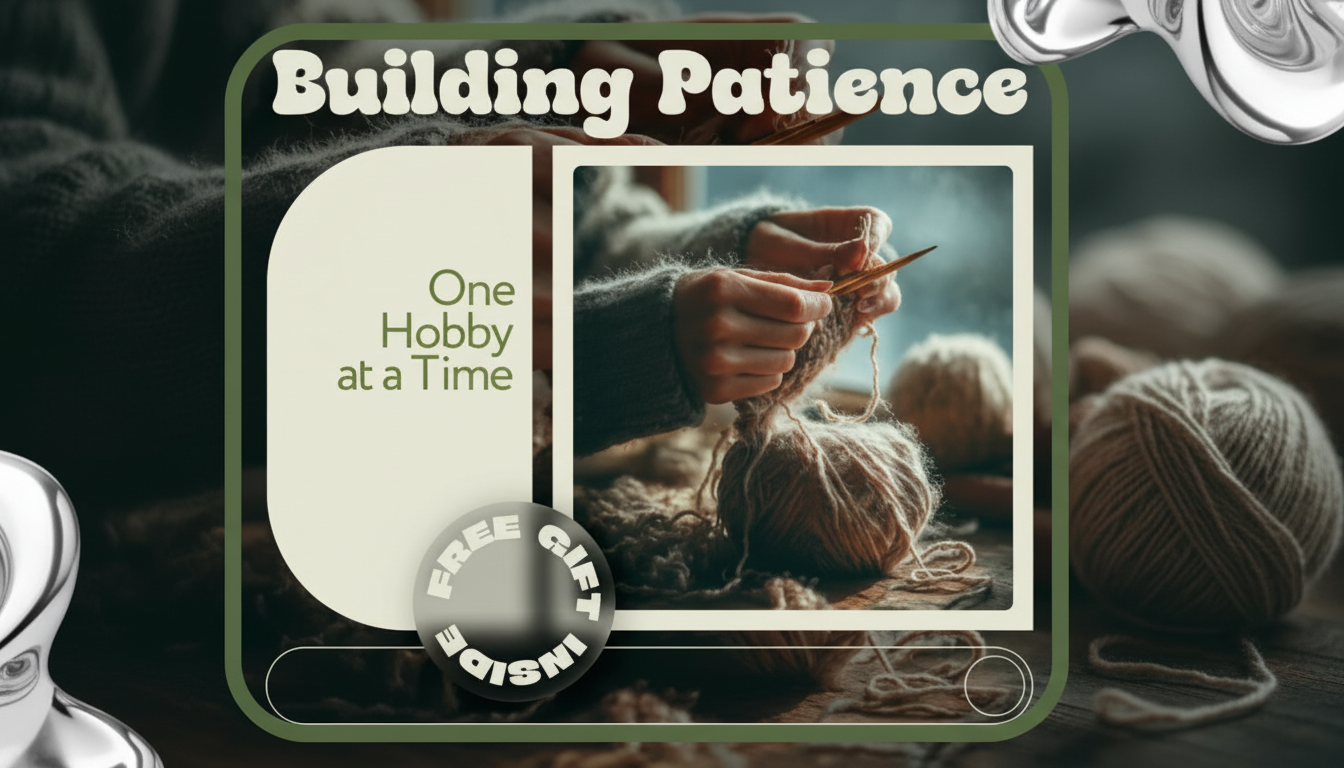
Patience is a trainable skill, not a personality trait. One of the fastest ways to build it is through small, repeatable hobbies that create gentle friction: waiting for a stitch to land correctly, repeating a scale, letting paint dry, or following a multi-step recipe. When you practice a hobby in short sessions, you’re not just “staying busy”—you’re strengthening specific patience muscles like attention control, emotional regulation, and follow-through so progress feels measurable and sustainable.
In real life, patience usually isn’t a single trait. It’s a bundle of skills that show up in ordinary moments: staying steady while a task feels slow, holding off on quick fixes that cause bigger problems later, and finishing what you start even when the reward is delayed.
Common impatience triggers include uncertainty (“Is this even working?”), boredom (nothing feels stimulating enough), perfectionism (a mistake feels like failure), and constant task-switching (the “just one more tab” loop). A practical goal isn’t perfect calm—it’s fewer impulsive pivots and more steady completion, especially in short, repeatable sessions.
Willpower tends to spike and crash. Hobbies, on the other hand, give you low-stakes repetitions: mistakes are safe, feedback is immediate, and improvement becomes visible over weeks. That steady exposure is what teaches the brain to tolerate slow progress without needing a pep talk.
Mindfulness is commonly defined as moment-to-moment awareness of experience with an attitude of openness and acceptance. For a deeper definition, the American Psychological Association is a helpful reference, and the NCCIH overview on mindfulness summarizes evidence and safety considerations.
Choose based on the patience skill that feels weakest right now: focus, frustration tolerance, or follow-through. Start smaller than expected—something that fits in 10–20 minutes is easier to repeat, and repetition is what creates lasting change. For the first month, stay process-first: prioritize consistency over outcomes.
| Hobby | Best for building | Why it trains patience | Beginner-friendly first step |
|---|---|---|---|
| Knitting or crochet | Frustration tolerance | Teaches undoing, fixing, and returning to the pattern calmly | Make a simple square; practice counting stitches |
| Jigsaw puzzles | Sustained attention | Rewards slow scanning and resisting the urge to force pieces | Sort by edges/colors; set a 15-minute timer |
| Bread baking | Waiting without rushing | Proofing times can’t be forced; timing improves with repetition | Try no-knead dough; track rise time and temperature |
| Gardening (container herbs) | Long-term follow-through | Growth is gradual; daily care builds consistency | Start basil or mint; water on a simple schedule |
| Watercolor or sketching | Letting go of perfection | Layers, drying, and practice reduce impatience with results | Paint a single object; limit to 2 colors |
| Guitar/piano basics | Deliberate practice | Improvement comes from repetition; progress is uneven but real | Learn one chord/scale; practice 5 minutes daily |
This plan is built for real schedules and real energy levels—small sessions that reduce resistance and make repetition easier.
If consistency breaks, lower the minimum session rather than quitting (10 minutes → 5 minutes → 2 minutes). The win is keeping the habit alive.
Over time, this builds a calmer relationship with effort—less dramatic motivation, more quiet follow-through. Harvard Health also discusses how mindfulness practice may help ease stress and anxiety, which often fuels impatience: Harvard Health Publishing.
Pick a hobby with built-in repetition and gentle errors, like jigsaw puzzles, knitting/crochet, or simple instrument practice. The fastest results come from short, consistent sessions (10–15 minutes) rather than long, intense bursts.
Pause, take one slow breath, label the feeling (“rushing” or “judging”), then do one tiny corrective step. If it still feels too sharp, lower the difficulty, shorten the session, or switch to a simpler project so you can keep practicing.
Many people notice small changes in 2–4 weeks with regular sessions, with stronger carryover in about 6–8 weeks. Progress is often uneven, and the clearest sign is faster recovery from frustration—not the absence of it.




Leave a comment