Grounded Goals, Steady Progress: A Practical Guide to Setting Realistic Expectations
Real change tends to look quieter than the highlight reel: fewer dramatic breakthroughs, more consistent reps. A realistic expectation isn’t “lower standards”—it’s a plan that matches real life: time, energy, responsibilities, and the occasional curveball. When expectations fit your actual week, goals become doable, progress becomes visible, and motivation has a chance to last.
Why expectations derail progress (even with strong motivation)
Motivation can get you started, but expectations determine whether you keep going. Many goal attempts stall for reasons that have nothing to do with laziness or lack of desire.
- Unrealistic timelines create a constant sense of failure, even when effort is consistent. When the calendar you imagined doesn’t match reality, every week feels “behind.”
- All-or-nothing thinking turns small slips into full stops. One missed session becomes “I’m off track,” which becomes “I might as well restart later.”
- Overcommitting time and willpower ignores fluctuating energy, stress, and competing priorities. A plan that works on your best day collapses on your busiest day.
- Progress often lags behind effort; expecting immediate results increases quitting risk. This is common in skill-building, wellness habits, and long projects where results arrive after repetition.
Research and practice in behavior change consistently point to the value of small, repeatable actions and clear plans. Helpful starting points include the American Psychological Association’s resources on behavior change, James Clear’s overview of implementation intentions, and the Stanford Behavior Design Lab’s approach to designing habits that work in real contexts (Behavior Design Lab).
Start with a clear baseline: time, energy, and constraints
A grounded plan begins with a baseline: what you can protect most weeks, not what you wish you could do. Before you set targets, estimate your real capacity.
- Estimate weekly time realistically by subtracting fixed commitments (work, caregiving, commute, admin). What remains is your true decision space.
- Create an “average week” plan, then add a “low-energy week” fallback so you keep momentum when life gets heavy.
- Identify constraint triggers (travel, deadlines, sleep debt) and pre-plan minimum actions for those periods.
- Set one priority goal per season (4–12 weeks) to prevent hidden overload from “just one more” improvement effort.
Baseline planner: make the goal fit real life
| Area |
Quick prompt |
Example output |
| Time |
How many minutes can be protected 3–5 days/week? |
30 minutes, 4 days/week |
| Energy |
When is focus highest most days? |
Morning before messages |
| Constraints |
What regularly disrupts routines? |
Two late meetings per week |
| Minimum |
What counts as success on a hard day? |
10 minutes + one note tracked |
Turn a vague goal into a steady plan
Vague goals are motivation magnets and follow-through traps. A steadier approach is to define what “done” looks like, then make weekly actions unambiguous.
- Define the outcome in plain language (what “done” looks like) and a behavior target (what happens weekly). Example: “Finish the course” + “Watch two lessons and do one practice set each week.”
- Break the goal into milestones that can be completed in 7–14 days. Short milestones reduce ambiguity and increase the odds of quick, credible wins.
- Use “if–then” planning to protect follow-through. If the schedule shifts, then you use the minimum plan instead of skipping entirely.
- Pick one tracking method: a checklist, a streak, or a weekly score. Multiple systems compete for attention and usually get abandoned.
Set expectations that prevent burnout
Consistency doesn’t require intensity; it requires repeatability. Expectations that assume perfect weeks create pressure that makes quitting feel like relief.
- Replace perfection with ranges: aim for 3–5 sessions/week rather than 7/7. A range anticipates real life and still drives progress.
- Plan for recovery and margin. Rest isn’t a reward you earn after perfection; it’s part of the system that keeps the system running.
- Separate identity from outcomes: missing a day is an event, not a label. This reduces the emotional cost of normal variation.
- Use “next small step” thinking after setbacks: one action that reopens the loop (a 10-minute session, a single page, one email draft).
Review weekly, adjust monthly: the steady-progress rhythm
Realistic expectations aren’t set once; they’re tuned. A simple cadence keeps goals aligned with your actual life.
A practical guide to setting realistic expectations
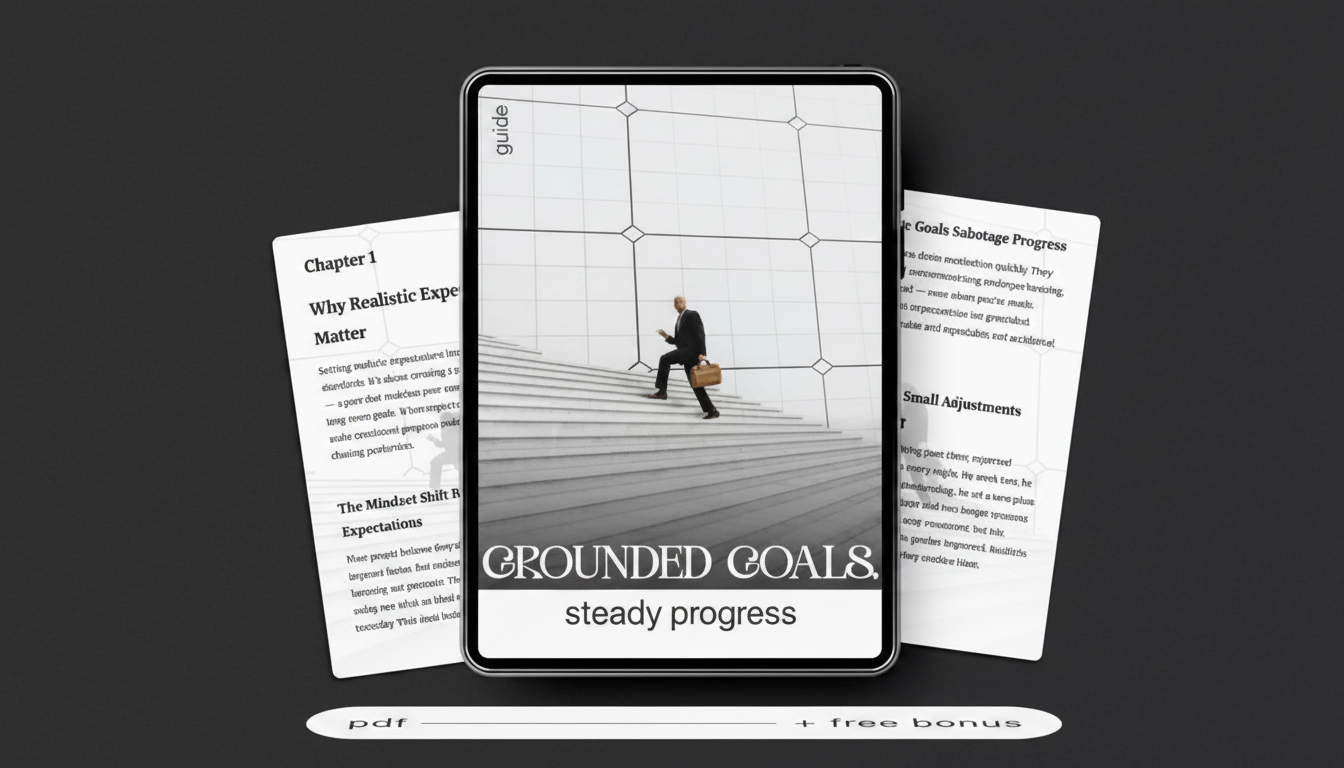
If you want a ready-made structure that turns good intentions into a workable weekly system, Grounded Goals, Steady Progress (digital guide) lays out a step-by-step method for realistic planning, steady habits, and expectation-setting that matches everyday constraints. It’s designed to be used as a reference you can return to: shape goals into doable actions, handle setbacks without spiraling, and track progress in a simple, repeatable way. Digital format, priced at $10.99.
Small scripts that make expectations kinder—and more effective
FAQ
How can realistic expectations still feel motivating?
Motivation grows when wins are frequent and believable. Use ranges (like 3–5 sessions), short milestones (7–14 days), and one simple tracking method so progress is visible and momentum feels earned.
What should a goal look like if time is limited?
Use a minimum viable plan: 10–20 minutes, three times per week, with a hard-day fallback that still counts as success. Keep one priority goal per 4–12 week season so limited time isn’t quietly split across too many projects.
How do setbacks fit into steady progress?
Treat setbacks as data, not a verdict. A weekly review plus an if–then plan helps you adjust quickly, and a “next small step” action lets you resume immediately without restarting from zero.
Recommended for you






Leave a comment