Why daily “micro-cleaning” beats weekend deep cleans
A tidy home doesn’t come from doing everything at once—it comes from doing a few things often. Daily “micro-cleaning” works because it’s predictable and light enough to repeat, even when the day is packed.
- Reduces decision fatigue: the same small set of tasks runs on autopilot, so you don’t negotiate with yourself.
- Stops buildup where it starts: high-friction zones like the kitchen sink, counters, entryway, and bathroom surfaces stay under control.
- Creates quick visual wins: a room can feel “done” without being perfect, which makes you more likely to keep going tomorrow.
- Makes deep cleaning easier: daily maintenance handles the basics, so weekly work is lighter and faster.
For health-focused guidance on when to clean vs. disinfect (and how), the CDC’s cleaning and disinfecting guidance is a practical reference.
Set a baseline: the 10–15 minute daily reset
The goal is a baseline you can keep on your busiest days. Choose a time anchor you already have—after breakfast, right after work, or before bed—and protect it with a timer. When the timer ends, stop. Consistency matters more than completion.
Daily Reset (10–15 minutes) — copy/paste into your routine
| Task |
Time |
Quick win |
| Clear and load dishes / start dishwasher |
3–5 min |
Sink looks clear immediately |
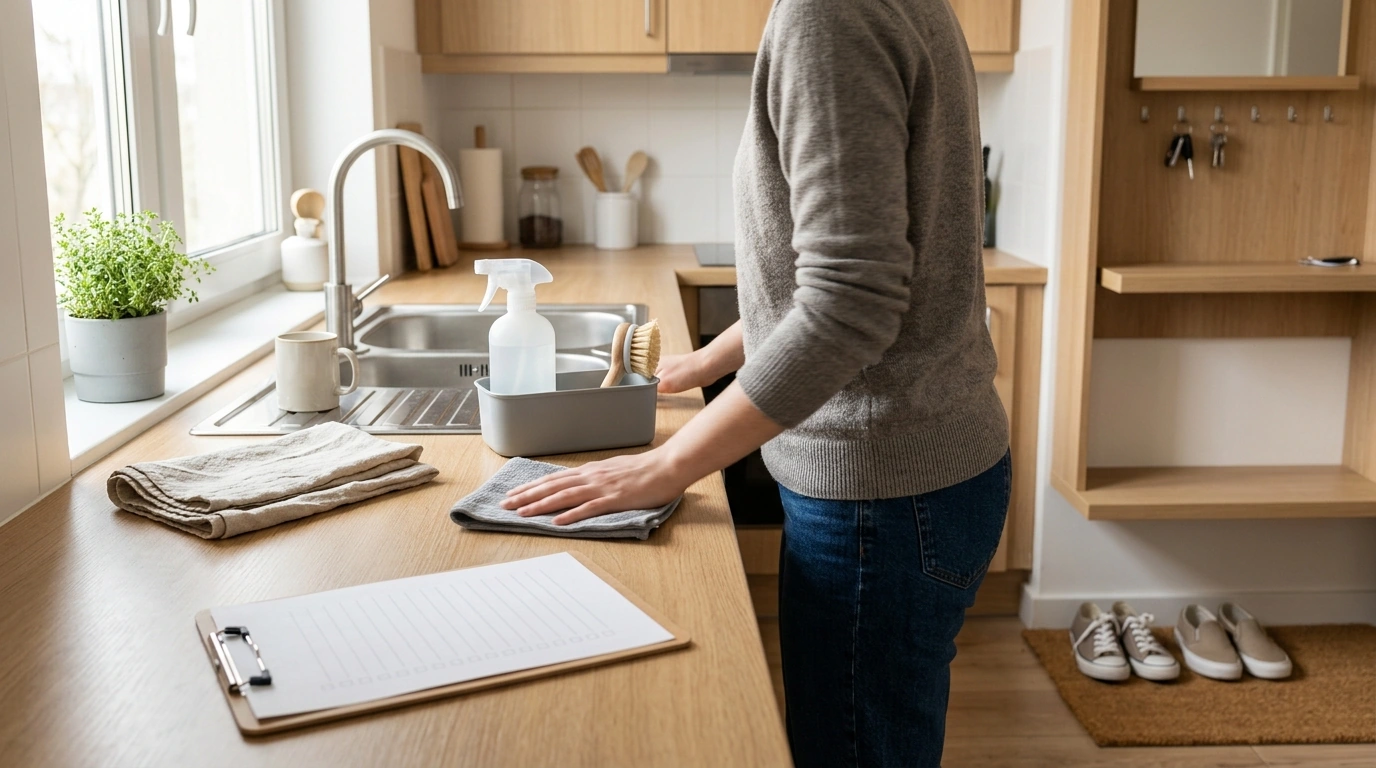
| Wipe kitchen counters + table |
2–3 min |
Food prep feels easier tomorrow |
| Tidy one “hot spot” (entryway, coffee table, couch area) |
3–4 min |
Room looks put-together fast |
| Quick sweep in the highest-traffic area |
2–3 min |
Crumbs and grit don’t spread |
| Trash/recycling check (only if needed) |
1 min |
Odors and overflow avoided |
Make cleaning a habit: a simple cue–routine–reward loop
Habits stick when they’re attached to real life. Use a cue you already do, keep the routine tiny, and add a small reward that makes the behavior feel complete.
- Cue: tie it to an existing action (start the coffee, feed pets, lock the front door, turn off the TV).
- Routine: start small—two minutes counts. You can scale up after the habit is stable.
- Reward: an immediate payoff (check the box, light a candle, make tea, five minutes of quiet).
- Lower friction: store supplies where they’re used; a small caddy beats hunting for products.
- Track it visually: a simple checklist reduces mental load and supports momentum.
For more on why tiny actions compound into lasting routines, the habit concepts popularized by James Clear are a helpful framework.
A minimalist checklist structure that works for busy people
A checklist shouldn’t be a guilt list. It should match the reality of your schedule and the needs of your home—functional, not flawless.
- Daily list: only what keeps the home running (reset, bathroom touch-up, one laundry micro-step).
- Weekly list: one focused zone per day (bathroom, floors, sheets, dusting, fridge check).
- Monthly list: low-frequency tasks (baseboards, vents, behind appliances, quick declutter pass).
- Keep it finishable: short enough that a hectic day still ends with “maintained.”
- Make it visible: printable or digital—out of sight often becomes off the radar.
If you want a ready-made structure that doubles as a habit tracker, the Clean Daily, Shine Always printable home cleaning checklist (digital download) is designed around minimalist daily resets, weekly zones, and “bare minimum” options for busy weeks.
Room-by-room daily touch points (the minimalist version)
Instead of “clean the whole room,” use quick touch points that prevent the most visible mess from settling in.
- Kitchen: clear the sink, wipe counters, quick stovetop check, take out food scraps as needed.
- Bathroom: wipe sink/counter, quick toilet swish if needed, hang towels, empty small trash when full.
- Living areas: reset surfaces, return items to their “homes,” quick floor pass in traffic lanes.
- Bedroom: straighten the bed, collect cups/clothes, start a laundry micro-step.
- Entryway: corral shoes/bags, keep mail in a drop zone, one-minute sweep if dirt shows.
For practical product-agnostic basics on what to clean and how often, the American Cleaning Institute’s cleaning basics is a solid guide.
The “one-load rule”: laundry without the overwhelm
Laundry gets overwhelming when it becomes a mountain. The one-load rule keeps it moving with tiny, repeatable actions.
- Choose one daily micro-action: start a load, switch it, or fold one basket—only one step if that’s all you have.
- Prevent sorting piles: use a hamper per person or per category (lights/darks/towels).
- Fold in a short window: five to ten minutes counts, especially when paired with a relaxing show or podcast.
- If daily laundry isn’t realistic: keep a fixed schedule, but still do one small daily step (collect and sort).
Use the checklist as a routine organizer (print + digital options)
To make evenings feel more “closed out,” a calming ritual can help the routine feel rewarding. The Essential Oils Relaxation Checklist for a calm end-of-day routine pairs well with a 10-minute reset—especially if scent and soft cues help signal that the day is done.
Printable habit builder: how to stay consistent when life gets busy
Recommended printable checklist
Shop the Clean Daily, Shine Always checklist here.
FAQ
How long should a daily cleaning routine take?
A solid baseline is 10–15 minutes for a daily reset, with a two-minute fallback on hectic days. Consistency beats intensity because it prevents mess from building up in the first place.
What are the most important daily cleaning tasks?
Prioritize dishes/sink, counters and key surfaces, a quick floor pass in high-traffic areas, and one clutter “hot spot” reset. Those four create the biggest visual and functional impact fast.
How can a checklist help make cleaning a habit?
A checklist removes decision-making, makes progress visible, and helps you track consistency over time. It also pairs well with cues and time anchors so the routine becomes automatic.
Recommended for you





Leave a comment