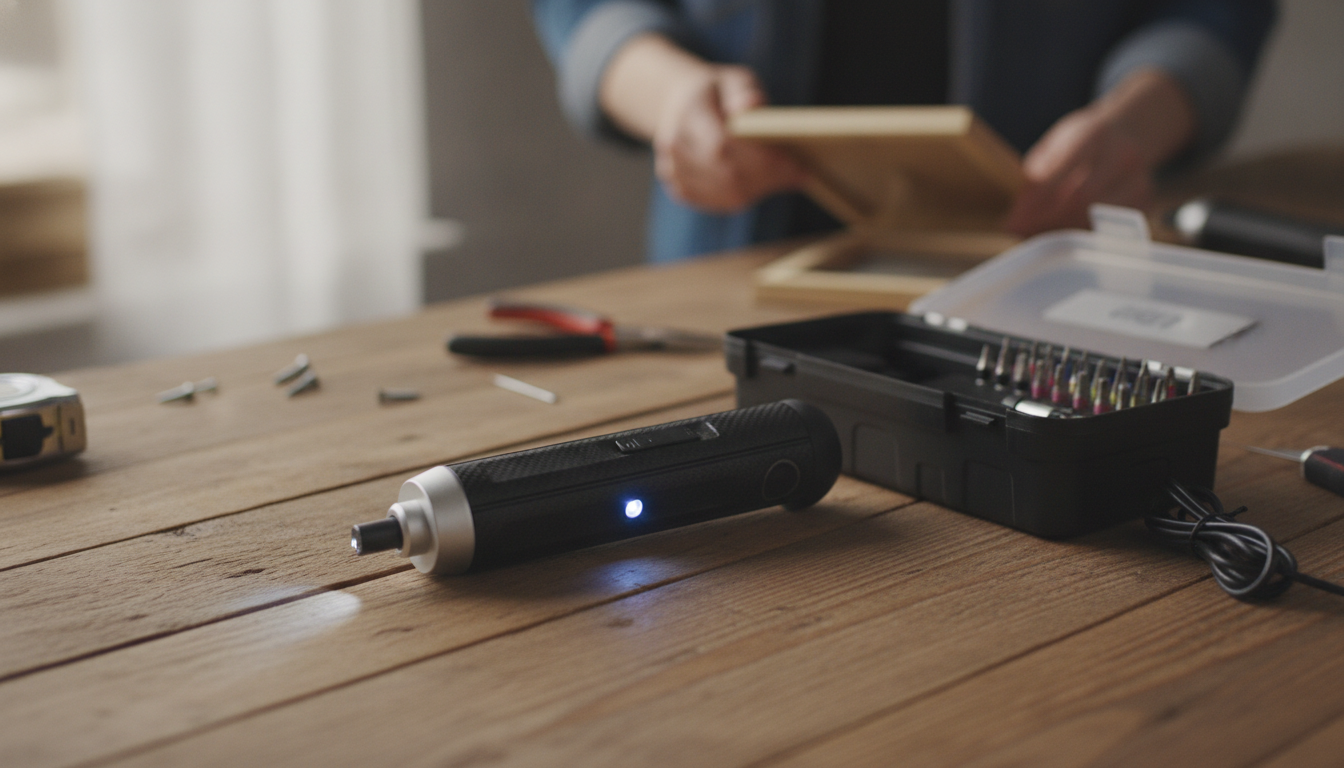
A small cordless screwdriver can handle most household tightening and assembly tasks faster than a manual driver—especially in corners, cabinets, and dim spaces. This guide breaks down what to look for in a 3.6V cordless screwdriver set with an LED light, what tasks it suits best, and how to use and maintain it safely.
A 3.6V cordless screwdriver is built for quick, repeatable screwdriving—not heavy construction. It’s most useful when you want controlled power without hauling out a full-size drill.
For everyday home use, 3.6V hits a practical sweet spot: enough power for common fasteners, but still compact and easy to control.
It’s also a smart “leave it handy” tool—keep it in a kitchen drawer, utility shelf, or tool tote, and it’s ready for loose knobs, wobbly chair screws, and quick installs without setup time.
An integrated LED work light sounds minor until you’re trying to drive a screw under a sink or inside a cabinet where your hand blocks overhead light. The LED helps the bit and screw head stay visible, which improves accuracy.
A cordless screwdriver is only as convenient as the bits you can grab quickly. For typical household work, prioritize a set that covers the most common screw heads and includes a simple way to keep everything together.
If you frequently work on furniture hardware, having multiple Phillips sizes matters more than having dozens of obscure bits. For electronics or hobby projects, smaller precision-style bits may be needed (and may be a separate kit depending on the set).
Use this quick checklist to confirm the tool matches typical home tasks and comfort needs.
| Feature | Why it matters at home | What to verify |
|---|---|---|
| 3.6V cordless platform | Keeps the tool compact for light-duty work | Intended for small fasteners and assembly rather than heavy drilling |
| LED work light | Improves visibility and alignment in tight or dark spaces | Light placement illuminates the screw head and bit tip |
| Forward/Reverse | Speeds assembly and disassembly | Easy-to-reach direction switch |
| Comfortable grip | Better control; less fatigue for multiple screws | Non-slip handle and balanced weight |
| Charging method | Convenient top-ups between tasks | Charging port/type and charge indicator (if present) |
| Included bits/case | Fewer extra purchases for common screws | Bit variety plus organized storage |
Small cordless drivers are great at preventing “gorilla torque,” but technique still matters—especially with particleboard, MDF, and softer hardware screws.
Practical tip: when assembling flat-pack furniture, use the cordless screwdriver to run screws close to seated, then finish the last tiny snug by hand if the material feels fragile or the hardware is soft.
For a deeper overview of lithium battery handling and safety considerations, see UL Solutions’ lithium-ion battery safety resources.
For general power tool safety reminders, review guidance from OSHA and the U.S. Consumer Product Safety Commission (CPSC).
Yes for typical flat-pack screws and light fastening. Use the correct bit, keep steady pressure, and avoid forcing long screws into dense wood without a pilot hole.
It improves visibility of the screw head and bit tip in cabinets, corners, and low-light areas, helping reduce slipping and stripped screws.
Start slowly, stop when the screw head seats, and use short bursts. For delicate materials, finish the last fraction of a turn gently if needed.






Leave a comment