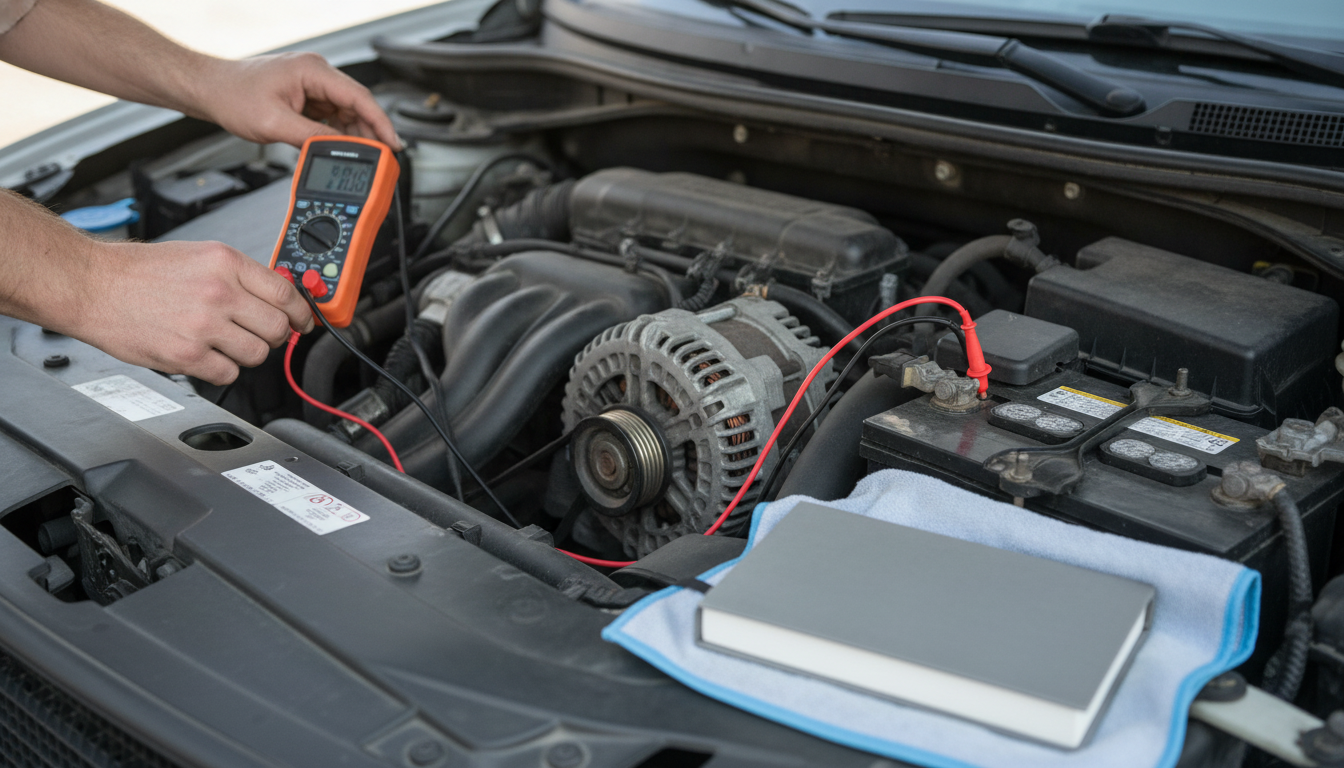
A weak alternator can look exactly like a bad battery: slow cranking, dim lights, warning messages, and random electronic glitches. The good news is you can confirm whether the charging system is doing its job with a few safe, repeatable checks—usually with nothing more than a basic digital multimeter and a careful approach around moving engine parts.
When the engine is running, the alternator converts engine rotation into electrical power. That power runs vehicle loads (lights, blower motor, infotainment, heated seats) and recharges the battery after starting. The alternator is only one part of a system that also includes the battery, serpentine belt, wiring/grounds, and a voltage regulator (often built into the alternator).
A strong battery can temporarily mask a failing alternator. The car may start and drive normally—until the battery drains low enough that ignition and control modules can’t stay powered.
If you need help locating charging-system fuses, warnings, or model-specific notes, the NHTSA Owner’s Manual Resources can help you find the right manual for your vehicle.
Set your multimeter to DC volts. Touch the red probe to the battery positive post and the black probe to the negative post. Whenever possible, contact the battery posts themselves (not the cable clamps) for a truer reading.
A fully charged 12V battery typically reads around 12.6V. If you see a noticeably lower number, charge the battery before judging alternator performance—testing a depleted battery can skew charging readings and make a good alternator look weak.
| Test Condition | Typical Reading | What It Usually Means |
|---|---|---|
| Engine off (resting battery) | ≈12.4–12.8 V | Battery state of charge; much lower may indicate low charge or battery issue |
| Engine idling (no major loads) | ≈13.8–14.6 V | Alternator charging normally (exact target varies by vehicle and temperature) |
| Engine idling (heavy electrical load) | ≈13.5–14.4 V | Healthy alternator should generally maintain charging above resting voltage |
| Engine running but voltage stays near resting | ≈12.0–12.8 V | Charging system not providing adequate output (belt, wiring, alternator/regulator) |
| Voltage consistently too high | ≈15.0 V or more | Possible regulator fault; risk of overcharging battery/electronics |
For additional background on state-of-charge concepts and why voltage matters, Interstate Batteries has a practical overview in their battery basics library: Interstate Batteries – Blog.
Start the engine and let it settle into idle. Measure voltage again directly at the battery posts. Most vehicles will show charging voltage in the high 13s to mid-14s. Some late-model “smart charging” systems vary voltage intentionally, so expect some movement—but not wild swings.
Next, raise engine speed to about 2,000 RPM (a helper makes this easier) and recheck voltage. It should remain stable or change slightly. If the voltage stays near resting-battery numbers, double-check belt condition/tension and inspect the alternator output cable, battery terminals, and engine/body ground connections.
With the engine idling, turn on high beams, cabin blower, and rear defroster (and heated seats if equipped). Measure battery voltage while the electrical demand is high.
Yes, but usually only briefly. The engine will run off the battery until voltage drops too far, at which point ignition, fuel systems, and critical modules may shut down and the vehicle can stall.
Many vehicles show roughly 13.8–14.6V with the engine running, though smart-charging systems can vary output by temperature and conditions. If you consistently see 15.0V or higher, the regulator may be overcharging.
No. Disconnecting the battery can cause voltage spikes that may damage electronics. Use a multimeter at the battery posts for a safer, more accurate charging-system check.







Leave a comment