
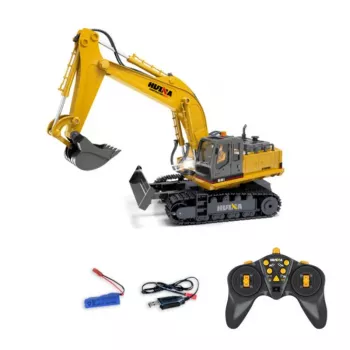
A multi-channel RC excavator is all about coordinated movement: driving, slewing, booming, and bucketing without feeling “toy-like.” This 1:14 model pairs 22-channel control with wide 680° rotation to enable realistic digging cycles, tighter maneuvering, and smoother job-site play for hobbyists who want more than basic up/down motions.
On an RC excavator, “channels” refer to independent control signals that let you operate separate functions without combining motions into a single simplified control. With more channels available, the experience tends to shift from “make it move” to “run the machine.” Paired with a broad 680° upper-structure rotation, you can keep your workflow going instead of constantly stopping to reposition.
| Function group | What it controls | Why it matters |
|---|---|---|
| Drive | Forward/reverse, steering via track control | Allows turning on the spot and creeping control when lining up to a dig |
| Upper structure rotation | Cab/house slewing (up to 680° on this model) | Faster repositioning between dig and dump points without moving the base |
| Boom | Main lift arm up/down | Sets digging depth and overall reach |
| Stick/arm | Secondary arm in/out | Controls crowding into soil and reaching into a pile |
| Bucket | Curl/dump motion | Determines scoop efficiency and clean dumping |
| Auxiliary features | Lights/sound/extra modes (varies by model) | Adds realism and can help visibility during evening play |
Scale isn’t just about looks. A 1:14 excavator often feels more planted and “equipment-like” because the chassis footprint and overall mass help resist tipping when you’re extended out to the side or lifting a full bucket. That stability can make slow, deliberate movements feel rewarding instead of frustrating.
If you want the controls to “click,” practice a repeatable cycle instead of random movements. The goal is consistency: keep the load close, swing smoothly, and avoid forcing the bucket at awkward angles.
This type of RC excavator is most satisfying when the operator wants more than novelty movement. Multi-channel control shines when you’re coordinating several actions at once—driving, slewing, and shaping material with purpose.
For general guidance on radio devices and interference considerations, the Federal Communications Commission (FCC) provides consumer-friendly information. For broader toy and product safety updates, including recalls, consult the U.S. Consumer Product Safety Commission (CPSC).
| Item | Detail |
|---|---|
| Product | 1:14 Scale RC Excavator with 22 Channels and 680° Rotation |
| Price | 325.01 USD |
| Availability | In stock |
“Channels” are independent control signals for separate functions. More channels typically mean more movements and features can be controlled individually instead of being combined. The exact channel-to-function mapping varies by model.
360° is one full turn, while 680° allows nearly two turns, which can reduce how often you need to reposition the tracks when moving between dig and dump areas. Rotation design and any built-in stops depend on the model’s internal layout.
Dry sand, loose soil, and fine gravel are usually the most satisfying because they flow into the bucket and dump cleanly. Sticky mud and oversized rocks can bog down the digging action and make cleanup harder. Keeping material pieces proportional to the bucket improves realism.






Leave a comment